
Sustainable Product Lifecycle Management in Pharma R&D (2026)
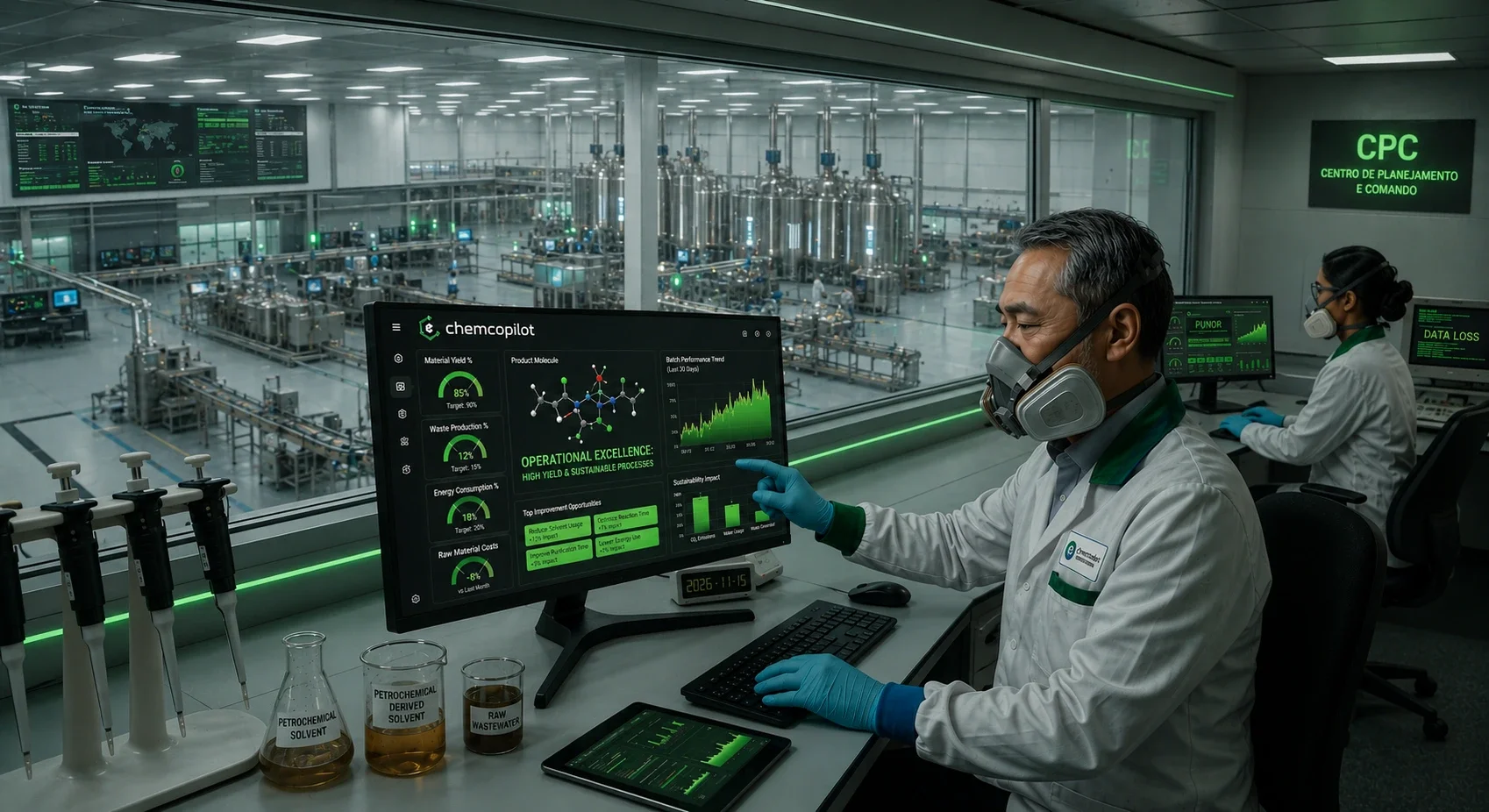
Sustainable Product Lifecycle Management in Pharma R&D: Green-by-Design Execution

Chief Product Officer at ChemCopilot. Former VP of Product at Noble.AI, Co-founder/CTO at Nanostellar (Quantum Simulation & Catalysts), and NASA/Harvard ACIS Software Team Leader. Over 25 years pioneering AI-driven molecular design, quantum materials modeling, and enterprise SaaS.
In the high-stakes world of pharmaceutical research and development, Product Lifecycle Management (PLM) has historically been driven by a single, uncompromising mandate: speed-to-approval. Because patent clocks begin ticking long before a therapeutic molecule enters clinical trials, drug development has traditionally operated under an "efficacy-first, environment-last" model. In this legacy framework, early-stage synthesis pathways were locked in based solely on speed, yield, and purity, while chemical waste, environmental footprints, and manufacturing energy consumption were treated as downstream problems for manufacturing plants to solve years later.
This localized view of drug discovery has become an operational and regulatory liability. Sweeping global regulatory frameworks—including the European Medicines Agency's (EMA) revised Environmental Risk Assessments (ERA) and the FDA’s strict directives on green chemistry integration—now force pharmaceutical developers to prove environmental sustainability before clinical authorization is granted.
Consequently, leading pharmaceutical R&D organizations are completely restructuring their PLM frameworks. By shifting from reactive remediation to proactive, green-by-design pipelines, these enterprises are proving that environmental sustainability and commercial yield are mutually reinforcing.
The Paradigm Shift in Pharmaceutical PLM
- Legacy Pharmaceutical PLM (Reactive Remediation): Focuses solely on rapid target binding and high yield percentages. Solvent toxicity, heavy metal catalysts, and processing waste profiles are addressed only after clinical trial locks, leading to massive downstream optimization costs and high carbon footprints.
- Circular PLM (Green-by-Design Synthesis): Embeds life-cycle assessment (LCA), alternative solvent models, and machine learning-driven process optimization directly into the initial lead discovery phase, eliminating hazardous waste before scale-up.
1. The Financial and Regulatory Catalysts of Green R&D
The transition toward sustainable product lifecycle management is a calculated response to shifting market economics. Historically, chemical waste was seen as a necessary cost of doing business. However, the cost of disposing of hazardous pharmaceutical waste has escalated significantly, with chlorinated solvent incineration fees rising by over 40% in recent years.
Under modern regulatory guidance, a drug's overall therapeutic score is increasingly tied to its manufacturing footprint. The revised EMA guidelines, for instance, mandate that pharmaceutical developers provide detailed data on the persistence, bioaccumulation, and toxicity (PBT) of the active drug substance and its major synthesis intermediates. A highly effective drug molecule that relies on restricted organic solvents or heavy metal catalysts faces extensive regulatory scrutiny, delaying approval times—a delay that can cost up to $1 million per day in lost market exclusivity.
2. Empowering the Best-in-Class Bench
High-level corporate environmental, social, and governance (ESG) targets are meaningless if they cannot be translated into actionable protocols at the laboratory bench. The shift to sustainable product lifecycle management relies on empowering bench scientists with the tools and data required to execute green-by-design workflows.
The best-in-class bench is a physical-digital hybrid environment where traditional manual glassware is augmented by advanced automation, real-time analytics, and predictive simulation layers. Scientists do not wait until scale-up to evaluate a synthetic route's environmental profile; they pre-screen and refine every step using three core methodologies:
A. Hansen Solubility Parameter (HSP) Solvent Mapping
Solvents represent up to 80% of the total mass of waste generated during a typical pharmaceutical synthesis campaign. At a best-in-class bench, chemists utilize automated HSP models to identify non-hazardous, bio-based alternatives (such as 2-methyltetrahydrofuran or ethyl lactate) that replace restricted, highly toxic solvents like dimethylformamide (DMF) or dichloromethane (DCM) without compromising reaction kinetics or yield.
B. Automated Microfluidic Synthesis Screening
Instead of synthesizing 10-gram batches to test reaction conditions, the modern bench relies on microfluidic flow chemistry. These systems run reactions at a micro-scale, reducing raw chemical consumption and subsequent waste generation by up to 99% per screening run, while gathering high-resolution thermodynamic and kinetic data.
C. Biocatalysis Integration
Rather than relying on scarce, toxic noble metal catalysts (such as palladium or ruthenium) that require energy-intensive, high-temperature reaction conditions, modern bench teams leverage engineered enzyme platforms. These biocatalytic pathways operate in mild, aqueous environments at ambient temperatures, significantly reducing the carbon footprint of the synthetic route.
The 3-Phase Best-in-Class Bench Workflow
- Phase 1 - In-Silico Screening: Generative models screen alternative solvents and pathways, flagging toxic elements before a single vial is uncapped.
- Phase 2 - Micro-Scale Run: Automated microfluidic flow systems validate the reaction, cutting raw material consumption and waste by 99%.
- Phase 3 - Real-Time LCA: The digital workbench records mass-balance metrics, generating real-time Life Cycle Assessments for regulatory compliance.
3. Solving Complex Formulation Challenges: The Case of Oncologic Products
The necessity for sustainable, high-precision R&D is nowhere more acute than in the development of oncologic products. Modern cancer therapeutics—including highly targeted small molecules, antibody-drug conjugates (ADCs), and kinase inhibitors—present exceptional chemical and physical processing challenges.
Because these active pharmaceutical ingredients (APIs) are highly potent and hydrophobic, their delivery mechanisms require intricate solvent matrices and precise physical structures. Even minor deviations during early processing can lead to structural polymorphism, rendering the therapeutic compound medically ineffective or biologically toxic. When a synthesis or formulation run fails due to poor polymorphic control, the resulting batch must be scrapped, generating hazardous, difficult-to-treat liquid waste streams that require energy-intensive high-temperature incineration.
The core bottleneck in this lifecycle is crystallization. Achieving the correct crystal polymorph is a complex thermodynamic challenge governed by non-linear relationships between solvent concentration, cooling rates, and nucleation kinetics. Solid-state nucleation rate J can be modeled by classical nucleation theory:
Where γ represents interfacial tension, Ω is molecular volume, k_B is the Boltzmann constant, T is absolute temperature, and S is the supersaturation ratio. Because of the exponential dependence on supersaturation (S) and temperature (T), even a minor 0.5 °C fluctuation inside a reactor can result in an unviable polymorph, wasting kilograms of precious API precursors.
Executive Insight: How ChemCopilot Solves Crystallization on Oncologic Products
"In modern pharmaceutical R&D, green-by-design isn't an ESG burden—it's a competitive advantage that eliminates costly scale-up failures and protects high-value oncology IP from day one."
— Jonathan Woo, Chief Product Officer at ChemCopilot
To bypass this massive R&D bottleneck, leading pharmaceutical organizations integrate ChemCopilot directly into their active oncology development loops. Rather than running hundreds of physical, high-waste crystallization trial batches in a laboratory hood, ChemCopilot is used to solve crystallization on oncologic products by treating crystallization optimization as a multi-objective active learning problem.
ChemCopilot's active learning engine ingests historical polymorphic datasets and real-time process inputs (solvability limits, heat transfer rates, and viscosity metrics). By evaluating these thermodynamic variables, ChemCopilot calculates the exact, greenest processing path—specifying the optimal cooling rate, solvent-antisolvent ratio, and seeding time to yield the target polymorph on the first try.
4. Comparative Operational Analysis: Traditional vs. Sustainable PLM
To quantify the strategic advantage of embedding green-by-design principles into pharmaceutical R&D, consider the operational comparison across a standard oncology development campaign:
| Development Parameter | Traditional Process Development | AI-Assisted Sustainable R&D (ChemCopilot) | Net Environmental & Operational Impact |
|---|---|---|---|
| Solvent Waste per Campaign | 4,500 Liters | 420 Liters | -90% Liquid Waste Generation |
| Failed Scale-Up Batches | 3 to 5 failed runs (polymorphic errors) | Zero failed runs (predictive control) | Eliminates $250k+ in scrapped batch costs |
| Crystallization Mapping Time | 6 to 8 Months | 3 to 4 Weeks | -85% Acceleration in R&D Cycle Time |
| Carbon Footprint (Energy usage) | High (Long, repetitive heating loops) | Low (Optimized, single-pass processing) | -72% Scope 1 & 2 Emissions Reduction |
5. Structuring the Integrated Enterprise: Data Security and Compliance
Managing these complex workflows across global, regulated pharmaceutical teams requires a secure, auditable software infrastructure. This is particularly critical in the R&D sector, where protecting high-value molecular patents and maintaining GxP compliance are top priorities.
Organizations cannot risk having scientists use fragmented spreadsheets or un-audited "Dark IT" tools to run active learning models. ChemCopilot addresses this enterprise challenge by acting as a secure, unified cognitive workspace, providing the core digital rails required to run sustainable development safely and compliantly:
- Granular Multi-Level Access Control: Custom role-based permission trees guarantee that laboratory technicians, external clinical research organizations (CROs), and compliance officers see only the data permitted by their specific access tier.
- Version Control & Audit Logs: Maintains an absolute, unalterable history of every molecular canvas modification, target optimization boundary shift, and crystallization simulation run for patent defense and regulatory validation submissions.
- Continuous Regulatory Synchronicity: The platform's integrated Knowledge Base features live API connections to international chemical registries, such as REACH, ECHA, and TSCA, ensuring compliance by design from day one.
6. Strategic Mandate for Pharmaceutical Leadership
The future of pharmaceutical R&D belongs to organizations that unify medical efficacy, operational speed, and environmental sustainability. Continuing to treat sustainability as a late-stage manufacturing problem introduces severe regulatory risk and delays product launch timelines.
By transforming your laboratory into a green-by-design workspace—empowering your best-in-class bench with active learning, and deploying advanced tools like ChemCopilot to resolve complex crystallization bottlenecks on oncologic products—you can compress developmental cycles, satisfy upcoming ESG regulations, and deliver life-saving therapies to market faster than ever before.
🚀 Accelerate Your Sustainable Pipeline & Eliminate Waste
Ready to deploy green-by-design active learning and predictive crystallization across your active pharmaceutical projects? Connect with Jonathan Woo and our solutions engineering team to evaluate ChemCopilot on your proprietary datasets under enterprise-grade IP protection.
- Compress Development Timelines: Screen 10,000 virtual formulations in seconds before heating a single beaker.
- Enterprise Security: Single-tenant data isolation, SOC 2 compliance, and strict API zero-retention guarantees.
- Seamless LIMS/ERP Integration: Connect directly to historical SCADA logs, vendor cost tiers, and REACH compliance feeds.
Schedule a Private Enterprise Demo & ROI Assessment → | Start Your 14-Day Free Commercial Lab Trial →
