
A Comprehensive Guide to AI-Powered DOE Across Global Industries
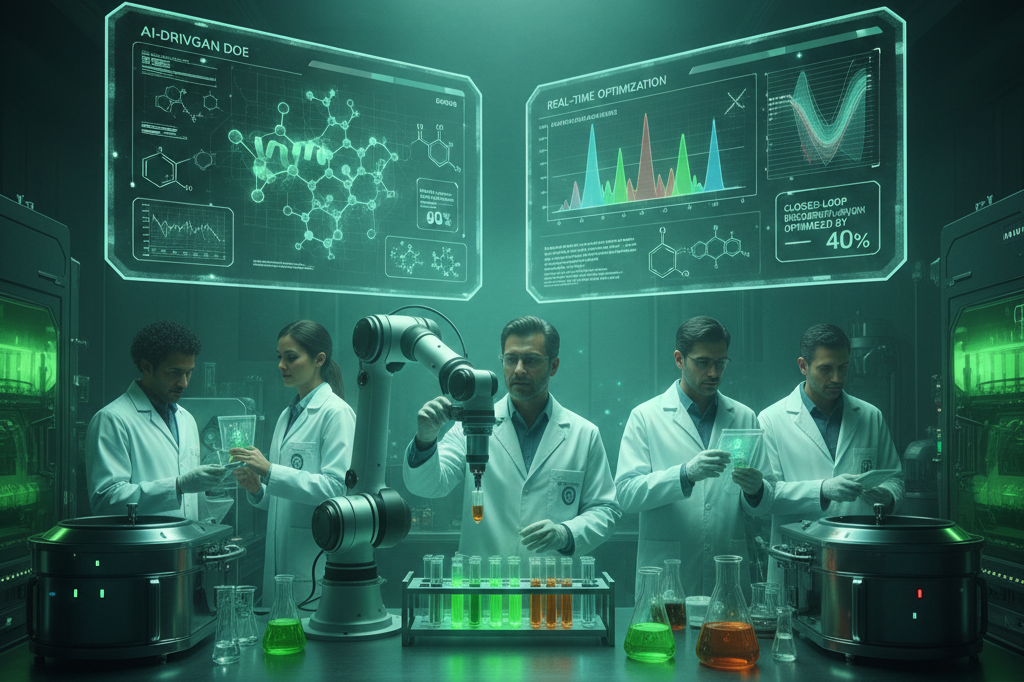
In 2026, Design of Experiments (DOE) has evolved from a niche statistical method used in pharmaceutical labs into the central operating system for global innovation. Whether it is a life-saving drug, a 2nm semiconductor chip, or a solid-state battery, the formula for success is the same: AI-driven DOE.
This comprehensive guide explores how DOE, powered by Artificial Intelligence, has become the "Architect of Efficiency" across the world's most critical industries.
1. The Core Philosophy: From "Trial-and-Error" to "Design Space"
The traditional "One-Factor-at-a-Time" (OFAT) approach—changing one variable while keeping others constant—is obsolete. In a world of complex chemical and physical interactions, OFAT is too slow and misses "interaction effects."
Design of Experiments (DOE) solves this by varying multiple factors simultaneously. By 2026, AI has supercharged this process, allowing engineers to define a Design Space: a multi-dimensional "safe zone" where quality and performance are guaranteed.
2. DOE Across the 2026 Industrial Landscape
A. Pharmaceuticals: The API Revolution
In the pharma sector, DOE is the bridge between Molecular Docking and the final Active Pharmaceutical Ingredient (API).
The Workflow: Once docking identifies a potent molecule, AI-DOE immediately maps out the most efficient synthesis route.
The Impact: It ensures 99.9% purity while reducing solvent waste by over 30%, aligning with the "Green Chemistry" mandates of 2026.
B. Semiconductors: Navigating the 1nm Frontier
As chip architectures become atom-scale, the margin for error is zero.
The Challenge: Balancing plasma density, gas flow, and etching time in a trillion-transistor environment.
The DOE Solution: Foundries use Bayesian DOE to run "Digital Twins" of the wafer. This identifies the exact parameters needed to maximize yield, which is the difference between a profitable product and a billion-dollar failure.
C. Energy & Battery Tech: The Race for Density
The transition to EVs depends on finding the perfect electrolyte-to-anode ratio.
The Challenge: Testing thousands of new material combinations for solid-state batteries.
The DOE Solution: AI-DOE uses Screening Designs to eliminate 95% of underperforming materials virtually, leaving only the top candidates for physical testing. This has compressed the battery R&D cycle from 10 years to 24 months.
3. The 2026 Advantage: "Closed-Loop" Innovation
The defining feature of 2026 is the Closed-Loop Lab. In these facilities, the DOE isn't just a plan on a screen; it’s an active conversation between AI and robotics:
AI Plans: The AI generates a DOE matrix based on previous data.
Robots Execute: Automated arms perform the physical experiments.
Real-Time Analysis: Sensors (Process Analytical Technology) feed results back to the AI.
Instant Refinement: The AI adjusts the next experiment in the DOE sequence based on what it just learned.
Industry Insight: Companies using AI-DOE in 2026 report a 40% faster time-to-market and a 25% reduction in R&D operational costs.
4. Why DOE is the Foundation of "Sustainability by Design"
In 2026, sustainability is a regulatory requirement, not a choice. AI-driven DOE allows companies to hit "ESG" (Environmental, Social, and Governance) targets by:
Reducing Energy Intensity: Identifying reaction paths that require lower temperatures.
Minimizing Waste: Pinpointing the exact amount of reagent needed to avoid excess.
Circular Materials: Optimizing the performance of recycled or bio-based materials to match virgin quality.
Conclusion: The Strategic Imperative
Design of Experiments is the common language of 21st-century engineering. It transforms "luck" into "certainty." For any organization in 2026—be it in Pharma, Tech, or Energy—mastering AI-driven DOE is no longer a competitive advantage; it is the price of entry into the future.
