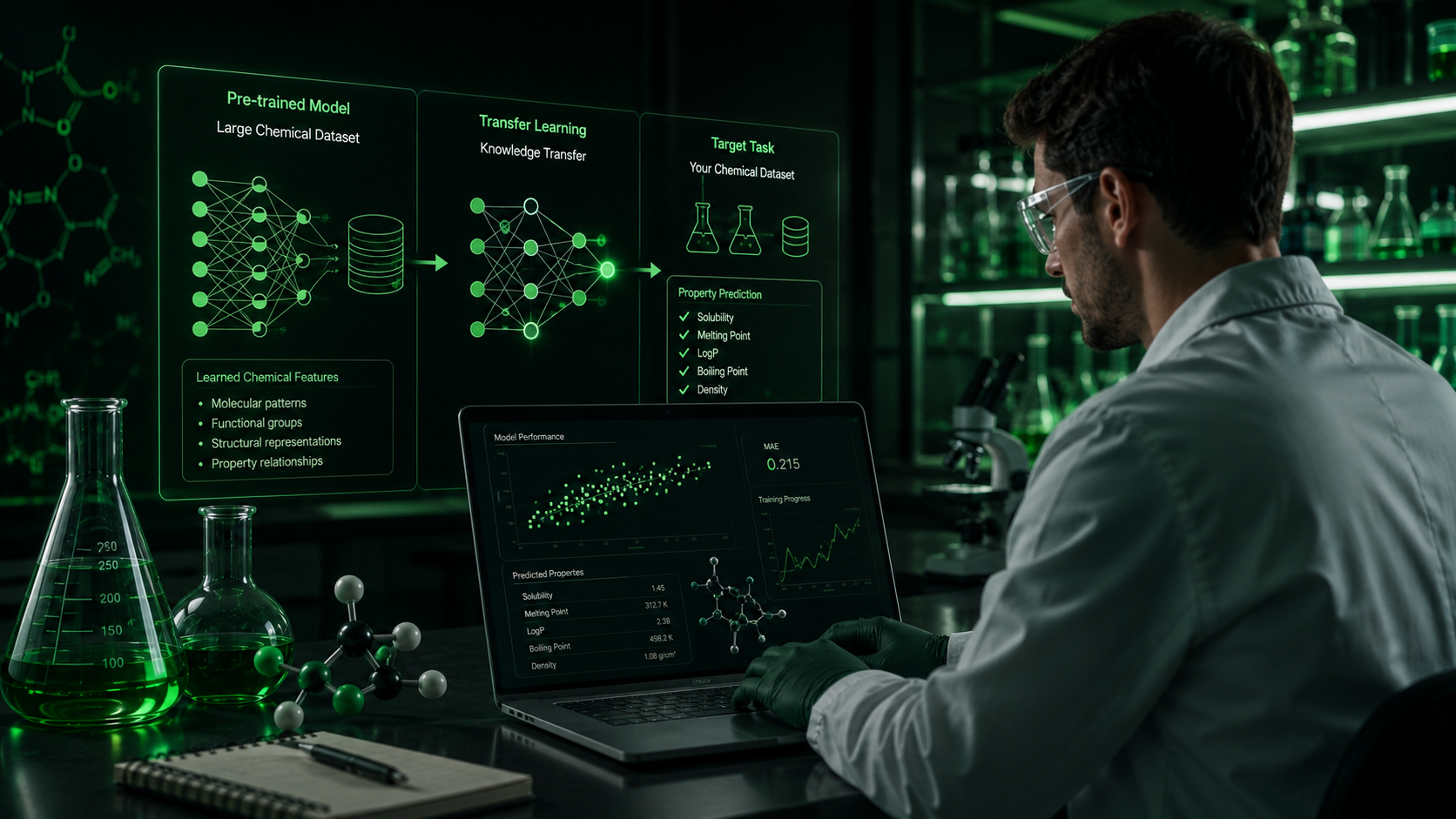
In corporate materials R&D, implementing machine learning models often stalls due to a frustrating paradox: **the data scarcity bottleneck**. While deep learning models possess an incredible capacity for predicting complex chemical trends—such as cross-linking density, toxicity profiles, or dielectric constants—they typically demand thousands of high-quality training examples to yield reliable accuracy.
For a specialty chemicals lab developing an advanced coating or a novel elastomer matrix, gathering that volume of data is practically impossible. Physical lab experiments are resource-intensive, analytical equipment queues are long, and historical datasets for a hyper-specific product variant might consist of only 20 or 30 reliable rows. Trying to train a standard machine learning model from scratch on a dataset that small leads to extreme overfitting, resulting in predictions that look flawless on paper but fail completely at the laboratory bench.
As we progress through 2026, **Transfer Learning** has emerged as the definitive solution to this limitation. By allowing models to apply knowledge gained from broad chemical spaces to narrow, proprietary targets, transfer learning enables R&D teams to deploy elite predictive modeling with minimal data requirements.
Training From Scratch
Data-Hungry ImplementationsRequires thousands of proprietary, clean data coordinates to map simple structural relationships. If your internal lab data lake is small, model accuracy drops and overfitting spikes.
Transfer Learning Pipeline
Pre-Trained Knowledge MappingLeverages deep structural rules pre-learned from hundreds of millions of public molecules. Reaches exceptional predictive precision using as few as 15 downstream lab results.
The Core Mechanism: How Transfer Learning Works
At its core, transfer learning operates on a simple principle: **a model that has already learned the "language of chemistry" does not need to relearn basic physics when analyzing your specific formulation.**
The practical deployment process breaks down into a two-stage sequential workflow:
Massive Pre-Training
A foundation model processes hundreds of millions of public molecules (PubChem/ChEMBL), learning basic covalent geometry, valency, and functional patterns.
Feature Extraction
The model converts your candidate molecular structures into rich, multi-dimensional vector maps (embeddings) that preserve structural context.
Downstream Tuning
The system exposes these pre-trained maps to your sparse internal data row parameters, mapping properties accurately with minimal runs.
Because the underlying architecture (such as a chemical transformer or a deep graph neural network) already understands chemical bond lengths, ring structures, and electronegativity trends from its pre-training phase, it only needs to learn the specific correlation between those properties and your physical target metric—such as glass transition temperature ($T_g$) or tensile module boundaries.
Practical Benefits on the Laboratory Floor
Transitioning from traditional scratch-trained algorithms to pre-trained transfer learning architectures delivers direct operational advantages to scaling chemical enterprises:
- Slashes Experimental Iterations: Instead of executing a massive 200-batch screening matrix to calibrate a new recipe, transfer learning allows you to run a 15-batch validation grid, using the model to virtually screen thousands of candidate alternatives in seconds.
- Monetizes Niche Knowledge: It resolves the data sparsity problem. Small, specialized product groups that previously could not leverage data science due to low sample volumes can now deploy elite predictive models instantly.
- Accelerates Substitution Timelines: When environmental regulatory bodies (like ECHA or the EPA) restrict an established additive, transfer learning models use pre-learned structural relationships to quickly suggest compliant, bio-based alternatives that match the original component's performance profile.
How ChemCopilot Automates the Transfer Learning Loop
While the mathematics behind transfer learning are highly effective, configuring the infrastructure—such as downloading raw model checkpoints from Hugging Face, adjusting network layers, and managing chemical tokenization syntax—traditionally required a dedicated team of computational data scientists.
**ChemCopilot** bridges this deployment gap entirely through its zero-code **Agent Lab** environment.
When you upload a standard tabular dataset of your mixtures into the panel, ChemCopilot does not simply run an isolated statistical linear calculation. Behind the scenes, the system's **ChemOptimize** engine automatically processes your ingredients through advanced, pre-trained molecular transformers (like ChemBERTa, MolBERT, or optimized tabular foundation structures). It instantly extracts deep structural vector embeddings, connects them with your local processing variables (temperatures, shear rates, ratios), and opens an active optimization loop tailored to your workspace.
Furthermore, because ChemCopilot couples these transfer learning models with its semantic **Knowledge Base**, your prediction loops run alongside live global compliance registries (REACH/ECHA) and your company's unstructured historical notes. This ensures that every AI-suggested recipe tweak or molecular structure modification is safe, legally compliant, and perfectly optimized for production scale-up from day one.