How AI is Transforming Chemical Research and Development Workflows 2026
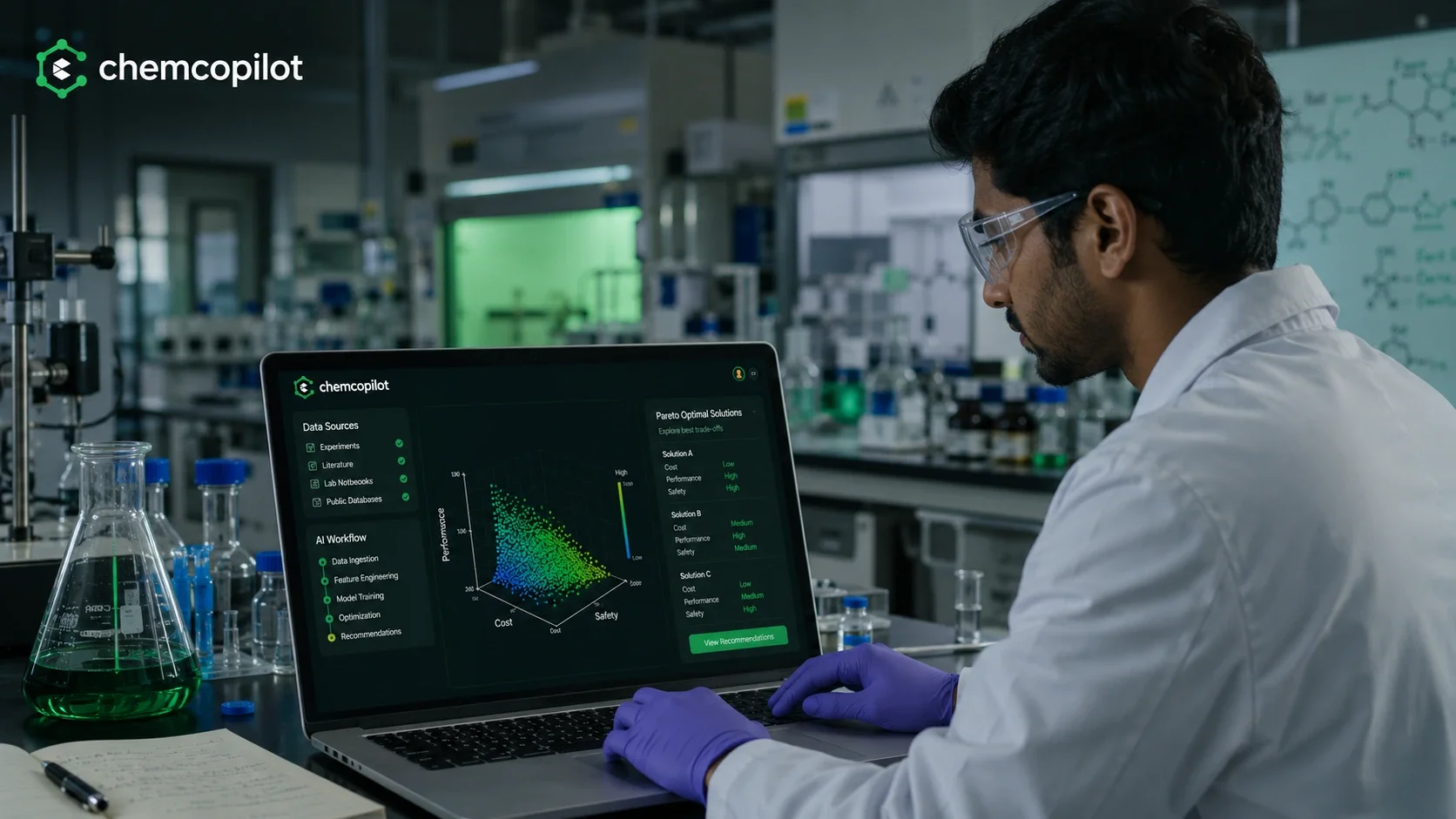
How AI is Transforming Chemical Research and Development Workflows

Chief Marketing Officer at ChemCopilot. Over 7 years of experience in B2B SaaS growth, deep-tech market research, and AI-as-a-Service (AIaaS) strategies for enterprise chemical, materials, and industrial sectors.
The chemical R&D sector has entered a period of rapid modernization. For decades, laboratories operated under the traditional Edisonian paradigm—a highly manual, intuition-driven method of trial-and-error experimentation. While this approach has driven materials innovation historically, it is no longer fast enough to keep pace with modern market demands.
Global R&D teams face compressed product lifecycles, volatile raw material supplies, and strict environmental regulations. To remain competitive, organizations are deploying artificial intelligence to shift development from manual bench trials into predictive, digital-first workflows. AI is transforming chemical research and development workflows, enabling companies to compress timelines, minimize physical waste, and secure valuable intellectual property at a fraction of the traditional cost.
This guide explores the six core pillars through which artificial intelligence and advanced machine learning platforms are reshaping the modern chemical and polymer laboratory landscape.
The 6 Pillars of AI-Driven Chemical R&D
01. Process Chemistry: Reaction Optimization with ReactWise
Moving a discovered molecule from a small lab trial to robust, scalable production conditions is traditionally a slow process. Finding the perfect balance of temperatures, catalyst loadings, and solvent mixtures has required exhaustive, wasteful experimental screens.
Process chemistry copilots like ReactWise address this challenge by providing algorithmic decision-making tools directly to wet-lab chemists. ReactWise integrates Bayesian optimization and proprietary transfer learning databases to "warm-start" reaction campaigns, reducing the experimental burden on R&D teams by up to 95%. Built specifically for chemistry workflows, it models non-linear variables and designs high-throughput experiments, eliminating scale-up bottlenecks.
02. Cognitive Assistants: The ChemCopilot Lab and Knowledge Assistant
While reaction-specific modeling optimizes single pathways, wet-lab scientists spend up to 80% of their time on administrative tasks—such as searching unstructured documentation, tracking inventory, and manually transcribing equipment outputs.
The ChemCopilot Lab and Knowledge Assistant addresses this by acting as a central cognitive workspace. Rather than functioning as a narrow, single-task calculator, ChemCopilot introduces the "Cognitive Assistant" framework to chemical discovery.
"In 2026, AI-as-a-Service in chemical R&D isn't about selling raw algorithms—it's about deploying context-aware software that integrates directly into enterprise workflows to drive quantifiable GTM speed and R&D margins."
— Paulo, Chief Marketing Officer at ChemCopilot
Why ChemCopilot Functions as a "Cognitive Assistant":
- Bridges Data Silos: Uses semantic reasoning to connect raw PDF data sheets, messy lab notes, and complex regulatory compliance texts straight to chemical structures.
- Operates with Chemical Context: Through an interactive molecular sketcher canvas, it understands covalent structures, valency, and physical boundaries natively, rather than treating chemistry as abstract numbers.
- Behaves as a Collaborator: Instead of requiring Python programming or database setup, chemists interact with the assistant conversationally, dynamically adjusting formulation constraints (e.g., maximizing shear strength while holding materials cost under a specific ceiling) as they would with an expert colleague.
03. Informatics: Materials Informatics and Cycle Time Reduction
In multi-component formulations—such as polymer matrices, elastomers, and coatings—scientists must track dozens of complex, non-linear ingredient interactions simultaneously. Static spreadsheets struggle to model how altering one polymer ratio affects viscosity, cure rates, and mechanical strength.
To coordinate these pipelines, R&D organizations are adopting targeted materials informatics platforms. To understand how these tools are structured, executives compare specialized platforms accelerating polymer and chemical R&D cycle times. By centralizing and structuring experimental data, these systems eliminate data siloing, allowing companies to analyze past failures, predict compound behaviors, and decrease physical development cycle times by over 70%.
04. Compliance: Green-by-Design and Sustainable PLM
Accelerating cycle times is only half the battle; new chemical formulations must also comply with global environmental mandates. Sweeping regulatory frameworks, including regional PFAS restrictions and updated European Environmental Risk Assessments (ERA), require chemical developers to account for toxicity and disposal impacts during the early-stage design phase.
R&D teams are addressing this by integrating compliance guardrails directly into early-stage modeling loops, a strategy analyzed in our detailed guide on sustainable product lifecycle management in pharma R&D. By linking predictive chemistry platforms with live regulatory safety databases, teams can virtually screen candidate compounds for environmental safety before moving to physical bench synthesis—avoiding the expensive scale-up bottlenecks associated with restricted organic materials.
05. Physics Solvers: Solving High-Value Solid-State Bottlenecks
Certain chemical steps present severe thermodynamic and processing containment challenges that traditional analytics cannot resolve. A prime example is the crystallization stage of highly potent molecules, such as oncologic active ingredients.
Because even minor 0.5 °C temperature fluctuations can result in unwanted structural polymorphs, pharmaceutical R&D teams historically relied on exhaustive physical trial-and-error screens. Modern AI platforms solve this by using active learning to map the Metastable Zone Width (MSZW) virtually, predicting the exact cooling, solvent, and seeding parameters required to achieve the correct polymorph on the first run—eliminating hazardous waste and de-risking pilot scale-up.
06. IP Security: Eliminating "Dark IT" and Securing Institutional Data
When laboratory software is too complex, chemists naturally find workarounds—storing formulation recipes in local Excel sheets, keeping raw performance metrics on personal desktop folders, and passing critical documentation via unvetted channels.
AI-driven cognitive assistants eliminate this "Dark IT" risk by providing an intuitive workspace that centralizes data assets. Platforms secure global corporate intellectual property through robust, role-based access controls and detailed, unalterable version histories, ensuring complete audit compliance while allowing teams to build on historical institutional knowledge.
Comparing Chemical AI & Informatics Ecosystem Tooling
To build an agile, modern lab infrastructure, R&D leaders must understand where different software models fit within their broader digital ecosystem:
| Platform Class | Representative Systems | Primary Analytical Mechanism | Target Lab User |
|---|---|---|---|
| Cognitive Assistants | ChemCopilot Lab Assistant | Semantic RAG, Molecular Canvas, Sparse Tabular ML | Bench Chemists, Lab Managers & Executives |
| Process Optimization Copilots | ReactWise | Bayesian Active Learning, Yield & Parameter Tuning | Process and Synthesis Chemists |
| Physics-Based Modeling | Schrödinger | Quantum Mechanics, Molecular 3D Dynamics | Computational Chemists & Molecular Designers |
| Enterprise Materials Informatics | Citrine Informatics, Enthought | High-Parameter ML Models, Customized Pipelines | Data Scientists & Corporate Informatics Teams |
| Structured Lab Database (LIMS) | Uncountable | Relational Testing Repositories, Database Schemas | Laboratory Managers & QA/QC Technicians |
Unifying Human Ingenuity and Machine Intelligence
Transforming your laboratory workflows does not mean replacing human expertise with algorithms. Instead, the most successful R&D organizations treat AI as a collaborative partner. By automating routine data retrieval, optimizing complex reaction spaces, and predicting formulation performance virtually, chemical enterprises allow their scientists to step back from administrative logistics and focus on pure molecular innovation.
🚀 Modernize Your R&D Workflows & Drive Commercial ROI
Ready to deploy a cognitive AI assistant across your active chemical and materials projects? Connect with Paulo and our solutions engineering team to evaluate ChemCopilot on your proprietary datasets under enterprise-grade IP protection.
- Compress Development Timelines: Screen 10,000 virtual formulations in seconds before heating a single beaker.
- Enterprise Security: Single-tenant data isolation, SOC 2 compliance, and strict API zero-retention guarantees.
- Seamless LIMS/ERP Integration: Connect directly to historical SCADA logs, vendor cost tiers, and REACH compliance feeds.
Schedule a Private Enterprise Demo & ROI Assessment → | Start Your 14-Day Free Commercial Lab Trial →